
Planning Guides · 3 August 2026
Beach Weddings on the Costa del Sol: An Honest Guide
A beach ceremony is one of the most requested things on this coast and one of the most misunderstood. Here is what a beach wedding on the Costa del Sol actually involves, from the practical realities of sand and wind to where the coastline is genuinely at its most beautiful.
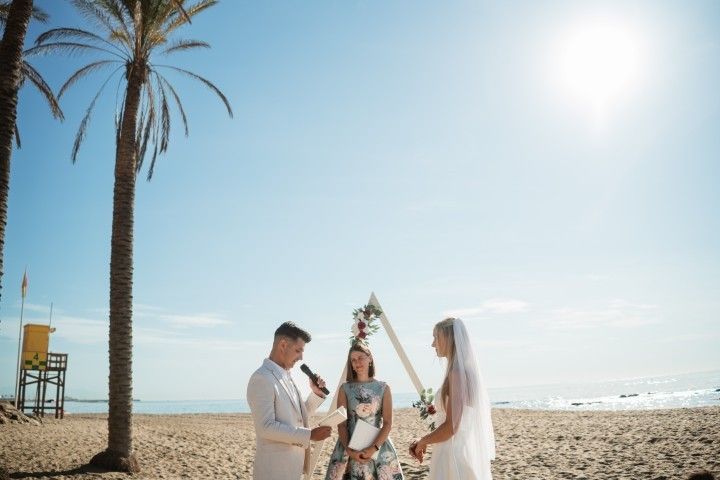
Ask couples what they picture when they imagine getting married in southern Spain and a large proportion describe some version of the same thing: bare feet, an arch, the sea directly behind them, warm light on the water.
It is an achievable image. We photograph and film it regularly along this coast. But there is a distance between the picture and the day, and most of the disappointment we have seen around beach weddings comes from couples who booked the picture without understanding the practical shape of the thing.
This is an honest account of what a beach wedding on the Costa del Sol actually involves: what works, what catches people out, and where this coastline is genuinely at its best.
Symbolic, Not Legal, and Why That Is Usually Good News
The first thing worth being clear about is that the beach ceremony most couples are imagining is almost always a symbolic one.
Spanish civil marriage has procedural requirements about officiants and approved locations that an open stretch of public beach does not generally satisfy. The workaround is not really a workaround at all: most international couples marry legally at home, quietly and administratively, and then hold the ceremony that matters to them here.
In practice this is liberating rather than limiting. A symbolic ceremony has no fixed script, no required wording, no legal timing constraints and no restriction on who conducts it. You can write your own vows, involve whoever you want, hold it wherever the light is best, and make it as short or as long as suits you. Couples who arrive slightly disappointed by the legal position usually end up preferring the freedom.
Legal requirements for foreign nationals in Spain do change, and they differ by nationality and residency. Our destination wedding guide to Spain goes into the ceremony types in more depth, but for anything binding, speak to a qualified professional.
Permissions Are the Part People Underestimate
Spanish beaches are public coastal domain. That has a straightforward consequence: you generally cannot simply arrive with thirty chairs and an arch and set up.
Each municipality along the coast manages ceremony permissions independently. Fees, lead times, how much space can be reserved, whether amplified sound is allowed, whether the setup can remain during peak bathing hours: all of it varies from town to town, and some of it varies by season within the same town.
None of this is a reason to abandon the idea. It is a reason to involve a planner who works in that specific municipality, early. The couples who find this stressful are the ones who discover the requirement three months out. The couples who find it trivial are the ones whose planner handled it before the date was confirmed.
The alternative that removes the question entirely is a beach club, chiringuito or seafront hotel with its own frontage. You get the same sea, the same light and the same barefoot feeling, with a private space, a bar, shade, toilets and somewhere for the reception to continue when the ceremony ends. For a lot of couples this is the better version of what they actually wanted.
Wind, Sand and Sound
Three practical realities shape a beach ceremony more than anything else.
Wind is constant on this coast, and it is not a problem until it is. A steady breeze is pleasant for guests and does lovely things to a veil and a dress in photographs. It is also the single biggest threat to ceremony audio. For film coverage we use radio microphones on the celebrant and the groom as standard, precisely because a beach ceremony is the environment where relying on ambient sound fails. If the vows matter to you on film, this is not a detail to leave to chance.
Wind also affects light structures, unweighted florals and anything paper. Order of service cards on chairs will be in the sea within ten minutes. Your florist will know this; make sure the arch is properly anchored.
Sand is harder to walk on than it looks in formal clothes. A processional across forty metres of soft dry sand is genuinely difficult in heels and not much easier in a long dress. The best beach ceremony setups we work at are positioned close to firm sand or a boardwalk access point, with a short walk rather than a long one. If you have elderly guests, this is worth a specific thought rather than a general one.
Reflected light is strong and it comes from below. Bright sand acts as an enormous reflector. In the middle of the day it produces squinting, hard shadows under the eyes and blown highlights on white fabric. In the late afternoon exactly the same property becomes a gift, filling shadows softly and wrapping warm light around everyone. The physics does not change; the time of day does everything.
Time It Late
If there is one decision that separates a beach wedding that photographs well from one that does not, it is the start time.
Between June and September, an outdoor ceremony on open sand before 18:00 is asking a lot of your guests and giving your photographer the least useful light of the day. From roughly two hours before sunset onwards, everything improves at once: the temperature drops, the day-trippers leave, the sea colour deepens, and the light goes from overhead and harsh to low and warm.
Sunset on this coast moves a long way through the year, from around 18:15 in December to nearly 21:45 in late June, so the right ceremony time in August is completely wrong in October. We go through how to structure the rest of the day around that in our Costa del Sol wedding day timeline.
Where the Coast Is at Its Best
The Costa del Sol is not one beach. It runs for well over a hundred kilometres and the character changes substantially along it.
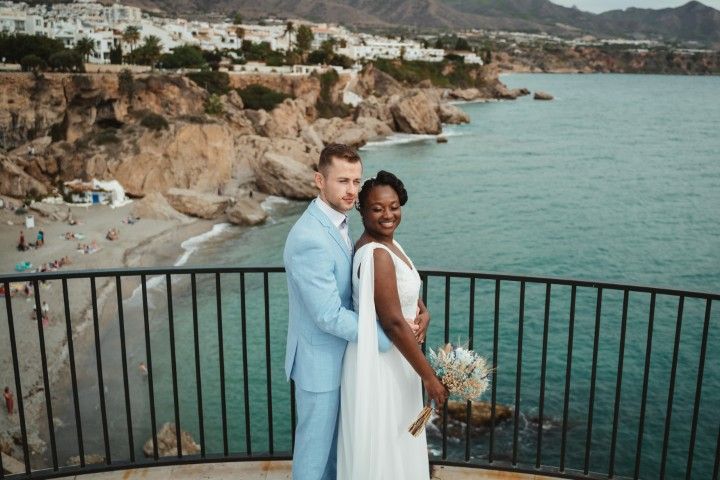
The eastern coast around Nerja and the Axarquía has the most dramatic shoreline in the province. Cliffs, coves, clear water and the Sierra Almijara rising directly behind the town. It is less developed than the west and the landscape does more of the work. We cover this stretch regularly, and weddings in Nerja consistently produce coverage with a strong sense of place.
Benalmádena and Torremolinos sit close to Málaga city and combine long accessible beaches with easy logistics for guests flying in. Benalmádena in particular has a mix of seafront and hillside settings within a short distance of each other, which gives a day visual variety without long transfers. See weddings in Benalmádena and Torremolinos.
Fuengirola and Mijas offer a straightforward coastal base with the white village of Mijas Pueblo ten minutes inland, which is an unusually useful combination: beach ceremony, old town portraits, no significant travel. See Fuengirola and Mijas.
Estepona and the western coast are quieter than Marbella with a genuinely charming old town and a long stretch of beach. Estepona suits couples who want the coast without the resort density.
Marbella has the highest concentration of beach clubs and seafront hotels with private frontage, which makes it the most straightforward place on the coast to hold a beach ceremony without wrestling with public beach logistics. Weddings in Marbella and our Marbella venue guide cover this in more detail.
What a Beach Wedding Looks Like on Film
Beach ceremonies film beautifully and they are also the environment that punishes an unprepared crew most reliably.
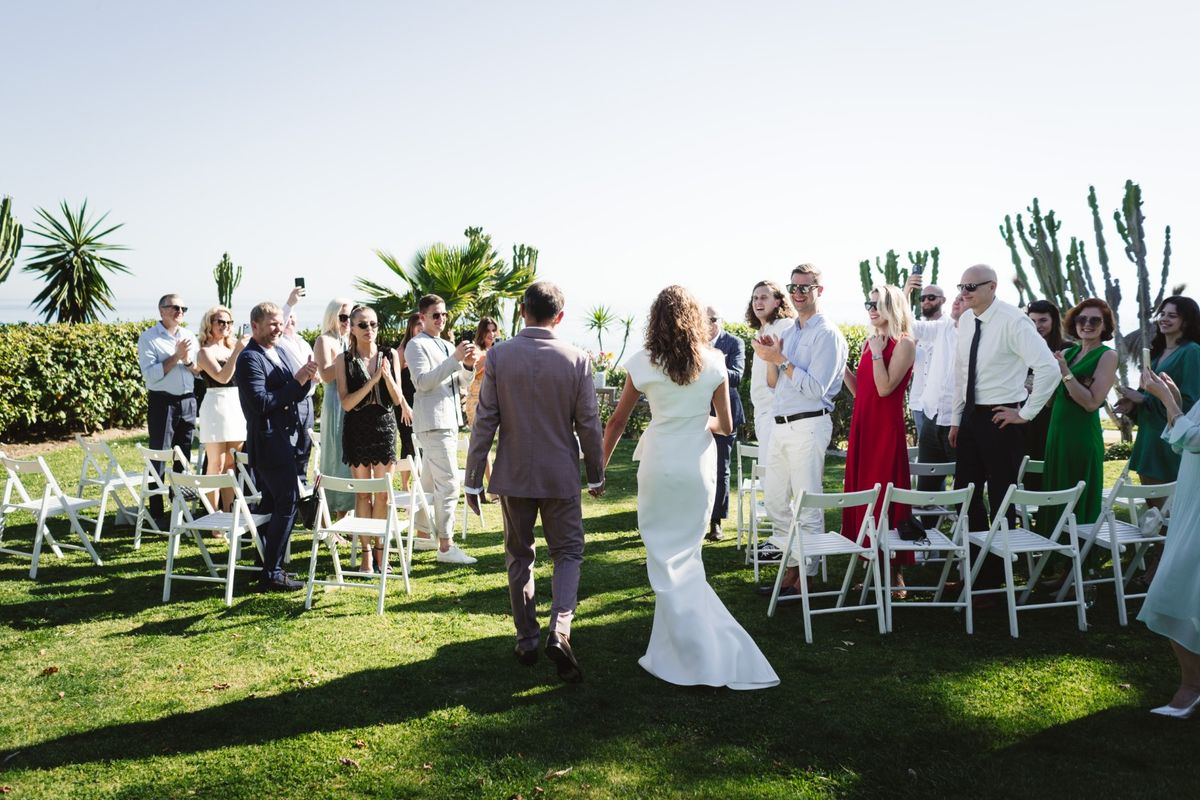
The good part is the material itself: open horizon, movement in the water, low light that carries warmth without needing help, and a natural sense of scale that a walled garden cannot offer. A film cut from a beach wedding at the end of the day has an atmosphere that is difficult to manufacture anywhere else.
The demanding part is entirely technical. Audio has to be captured on radio microphones rather than ambient. Exposure changes fast as the sun drops, so the coverage has to keep pace. Sand and salt air are hard on equipment, which is a crew problem rather than a couple problem, but it is the reason experience on this specific coast matters more than it might sound.
If you are still deciding whether to include film at all, our piece on whether wedding videography is worth it addresses that honestly, and a beach wedding is one of the stronger arguments for it: the sound of the sea behind your vows is the part that photographs cannot hold.
Is a Beach Wedding Right for You?
It suits couples who want the setting to do the work, who are relaxed about a public element to the day, and who are prepared to schedule around the light rather than around convention.
It suits you less if you want a large formal seated ceremony, if guest comfort in heat and on uneven ground is a significant concern, or if the idea of anyone in swimwear appearing in the middle distance would bother you on the day.
There is also a middle path that a lot of couples end up choosing and are glad they did: a ceremony at a seafront venue or beach club with its own private stretch, keeping the sea, the light and the barefoot atmosphere while removing the permissions, the public and the logistics. It is not a compromise so much as a more practical route to the same feeling.
We Would Be Happy to Help
We photograph and film weddings along the whole length of this coast from our base in Málaga, from Nerja in the east to Estepona in the west, with no travel fees. Beach ceremonies are something we work with constantly, and we have a fairly detailed sense of which stretches of coast work at which times of day and year.
You can see how we approach coverage on our wedding photography and wedding film pages, browse real weddings from along this coast, or look at pricing for how packages are put together.
If you have a date in mind, check availability, or just get in touch and tell us what you are picturing. Even if you are only at the stage of wondering whether a beach ceremony is realistic for the number of guests you have, that is a useful conversation to have early.
Planning a wedding in Málaga?
We are based on the Costa del Sol and photograph and film weddings across Málaga, Marbella, Nerja, and wider Andalusia. Tell us your date and venue - we are happy to help before you have made any decisions.
Frequently Asked Questions
- Can you legally get married on a beach in Spain?
- A legal civil marriage in Spain must take place before an authorised officiant in an approved location, which in practice rules out an open stretch of public beach for most couples. What is entirely possible, and very common on this coast, is a symbolic beach ceremony: no legal weight, complete freedom over wording, timing and location. Most international couples complete the legal marriage at home and hold the symbolic ceremony here. Requirements change, so confirm the current position with a qualified professional or your consulate rather than relying on any guide, including this one.
- Do you need a permit for a beach wedding ceremony on the Costa del Sol?
- Usually yes for anything involving setup. Beaches in Spain are public coastal domain and each municipality manages permissions for ceremonies, chairs, arches and sound differently, with different fees, lead times and rules about how much of the beach can be reserved. A local planner who works in that specific town will know the current process. This is the part of a beach wedding that most often surprises couples, and it is worth resolving early rather than late.
- What time of day is best for a beach ceremony?
- Late afternoon or early evening, without much competition. Midday sun on open sand is harsh on guests and unflattering in photographs, with strong overhead shadows and heavy contrast. In the last two hours before sunset the light softens, the sand cools, the beach empties, and the sea takes on the colour people picture when they imagine a wedding here. In summer that means a ceremony after 18:00 or even 19:00.
- Will the beach be busy with the public?
- In July and August, yes, on the main resort beaches. This is manageable rather than ruinous. Choosing a quieter cove, holding the ceremony later in the day when the beach clears, or using a beach club or seafront venue with its own reserved frontage all solve it. On a public beach in peak season, expect other people in the wider scene and plan the ceremony position so the sea, not the sunbeds, is the backdrop.
- What should guests know before a beach wedding?
- Tell them about the sand. Heels sink, and a short walk across soft sand in formal shoes is genuinely difficult for older guests. Flat shoes, or a ceremony position reachable from a boardwalk or promenade, removes most of the problem. It is also worth mentioning that coastal evenings cool down faster than a beach holiday suggests, so a light layer is not a bad idea from September onwards.
Planning a wedding in Málaga?
We cover the full Costa del Sol and wider Andalucía. Whether you have already chosen your venue or are still exploring, we would be glad to help - and to capture the day.