
Planning Guides · 3 August 2026
Elopements and Small Weddings in Andalucía
An elopement is not a smaller version of a wedding. It has a different shape, a different pace and a different set of decisions. Here is how intimate weddings work in Andalucía, and why this part of Spain suits them unusually well.
There is a particular kind of relief that shows on couples who have chosen to elope. It usually appears about twenty minutes into the day, once it becomes clear that there is nothing to manage, no one to seat, and nowhere anybody has to be at a specific time.
An elopement is not a smaller wedding. It is a structurally different day, with a different pace and a different set of decisions, and it suits some couples far better than the alternative. Andalucía happens to be one of the best places in Europe to do it, for reasons that are practical as much as scenic.
This is how intimate weddings work here, based on the ones we photograph and film across Málaga, the Costa del Sol and inland Andalucía.
Why Southern Spain Works for This
Three things make Andalucía unusually well suited to small weddings.
The distances are short. From Málaga you can reach the coast in ten minutes, a white village in thirty, the mountains of the Serranía in ninety and Granada in an hour and a half. For a full wedding this matters little, because everything happens at one venue. For an elopement it changes what is possible: a ceremony on a cliff in the morning and portraits in an old town in the afternoon is a realistic day here in a way it is not in most destinations.
The light is reliable and long. Between April and October you can plan an outdoor ceremony with genuine confidence, and in summer the usable evening light runs past nine. When there are only two of you, the schedule can bend entirely around the light rather than around a venue's dinner service.
The infrastructure exists without being obligatory. There are enough celebrants, planners, florists and small restaurants used to working with international couples that an elopement is easy to arrange, but nothing about the region requires you to use a wedding venue at all. You can have a day that looks nothing like a wedding package and still have everything you need.
The Legal Question, Briefly
Most couples eloping to Spain from abroad find that a legal Spanish marriage is more administratively demanding than the day itself warrants. The documentation varies by nationality, needs translation and apostille, goes through the local civil registry, and the timescales are not always predictable.
The route almost everyone takes is to complete the legal marriage at home, usually as a short administrative appointment, and to hold a symbolic ceremony here. For an elopement this is close to ideal. A symbolic ceremony has no legal requirements at all, which means no approved venue list, no fixed wording, no officiant restrictions and no time-of-day constraints. You can hold it at sunrise on a headland if that is what you want.
Our destination wedding guide to Spain covers the ceremony types in more detail. For anything binding, speak to a qualified professional or your consulate, because requirements do change.
Where Intimate Weddings Work Best Here
Different parts of Andalucía give an elopement a completely different character.
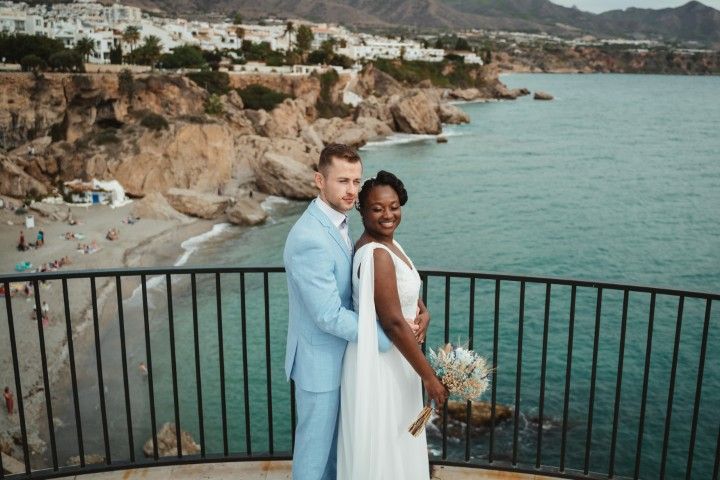
The eastern coast around Nerja. Cliffs, coves, clear water and the Sierra Almijara rising directly behind the town. The coastline here is the most dramatic in the province and the least resort-like. A ceremony on a viewpoint above the sea, followed by portraits along the cliff path and dinner in the old town, is a day that needs almost nothing added to it. See weddings in Nerja.
Ronda and the Serranía. A gorge, an eighteenth-century bridge, an old town of whitewashed lanes, and mountain landscape in every direction. Ronda gives an intimate wedding a sense of scale that coastal settings do not, and at altitude it stays comfortable in summer when the coast does not. Our Ronda venue guide covers the area in depth, and we work there regularly from our Ronda coverage.
Granada. The Albaicín, the carmen gardens, the view of the Alhambra from San Nicolás. Granada suits couples who want architecture and history rather than landscape, and it photographs unlike anywhere else in Spain. See weddings in Granada.
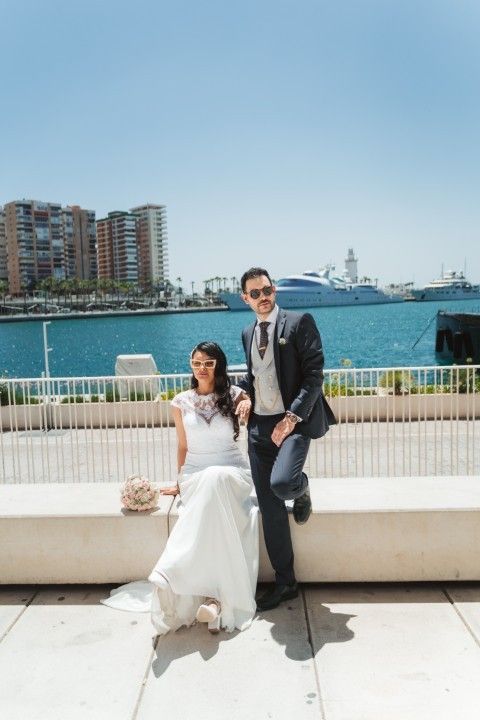
Málaga city. Underrated for this. The old town, the Alcazaba, the harbour front and the cathedral quarter give a compact, varied day with no travel at all, and the coast is ten minutes away when you want it. See weddings in Málaga.
Mijas and the white villages. Whitewashed streets, hillside views over the coast, and a scale that feels personal rather than grand. See weddings in Mijas.
What Actually Changes Without Guests
This is the part couples tend not to anticipate, and it is worth understanding before deciding.
Time stops being scarce. A full wedding day is a sequence of transitions that all take longer than planned. An elopement has almost none of them. What normally feels like a compressed forty-minute portrait window becomes two unhurried hours, which changes what the photographs look like. There is space to walk somewhere, to wait for the light to move, to stop for a coffee halfway through.
The two of you are the entire day. With no guests to greet, no speeches to sit through and no room to work, the day's attention is entirely on your own experience of it. Couples consistently describe this as the thing they underestimated most.
Direction matters more. At a wedding, most of the best photographs come from things happening between other people. At an elopement, there is only the two of you, which puts more weight on how the session is guided. This is why couples who elope tend to prioritise finding a photographer they feel genuinely comfortable with, rather than one whose portfolio simply looks right. If you have never been photographed properly before, a couple or engagement session beforehand is the single most useful preparation there is.
The record of the day becomes disproportionately important. With no guests, there are no other cameras, no phone footage, no one else's memory of it. What exists afterwards is what was documented. Most couples who elope reach this conclusion on their own and spend a larger share of a smaller budget on coverage as a result.
A Realistic Shape for the Day
There is no template, but the days that work well tend to have a similar rhythm.
Coverage usually begins an hour or so before the ceremony, with getting ready somewhere with good light. The ceremony itself is short, often fifteen or twenty minutes, and frequently in a place that would be impossible for a larger group: a headland, a viewpoint, a garden, a rooftop.
Afterwards, rather than an hour of group photographs, you go somewhere. This is the part that only works at this scale. Two people can move between three locations in an afternoon; sixty cannot. A coastal ceremony followed by old town portraits, or a mountain ceremony followed by a walk into the landscape, gives a set of images with real variety from a single afternoon.
The day usually ends with dinner somewhere chosen because you want to eat there, not because it can seat a party. Some couples want that documented; many prefer the coverage to end with the last light and to have dinner to themselves. Both are good answers.
Total coverage is commonly three to five hours. Our guide to how many hours of coverage you need goes into this for full weddings, and an elopement genuinely is the case where a shorter package covers everything rather than compromising.
Film at an Elopement
Film is often assumed to be a full-wedding thing, and at an elopement it does something quite specific.
There are no speeches, no first dance and no reception. What there is instead is the ceremony itself, usually more emotionally exposed than at a larger wedding because there is no audience to perform for, and the landscape you chose to be in. Vows spoken between two people on a cliff above the sea, with the actual sound of that place around them, is material that photographs cannot hold.
An elopement film is short, usually a few minutes, and tends to be more atmospheric than narrative. For couples who have chosen not to have witnesses, it is also the only way anyone else will ever experience the ceremony. Our wedding films page covers our approach, and whether wedding videography is worth it addresses the underlying question honestly.
When to Do It
Elopements are one of the few kinds of wedding where the off-season is genuinely better rather than merely cheaper.
In winter and the shoulder months the locations are empty. The Balcón de Europa in Nerja, the viewpoints of Ronda, the Albaicín in Granada: places that are crowded with visitors from June to September are quiet in November or February, and having them effectively to yourselves changes both the experience and the photographs. Winter light in Andalucía is low-angled through much of the short day, which is generous rather than limiting.
The trade-off is a shorter day and a real chance of rain. For a small group with a flexible plan, that is usually an acceptable risk. Our month-by-month guide to the best time of year on the Costa del Sol sets out the whole year in detail.
We Would Be Happy to Help
We photograph and film elopements and small weddings across Andalucía from our base in Málaga, and they are some of the days we most enjoy working. The pace is different, the scope for the unplanned is greater, and the results tend to feel less like wedding photographs and more like a record of two people in a place they chose.
If you are considering it, we are happy to talk through locations, timing and the shape of a day before anything is booked. Tell us roughly what you are imagining and we can usually suggest two or three places that fit it.
You can see how we work on our wedding photography and couple sessions pages, look at real weddings across the region, or see pricing for how coverage is structured. To find out whether a date is free, check availability, or simply get in touch.
Planning a wedding in Málaga?
We are based on the Costa del Sol and photograph and film weddings across Málaga, Marbella, Nerja, and wider Andalusia. Tell us your date and venue - we are happy to help before you have made any decisions.
Frequently Asked Questions
- Can you elope in Spain as a foreign couple?
- You can hold a wedding of any size in Spain, but the legal side is the part that needs care. A legal civil marriage requires documentation that varies by nationality and residency, needs translation and apostille, and has to go through the local civil registry. The timescales are long enough that most international couples marry legally at home and hold a symbolic ceremony in Spain. For an elopement this works especially well, because a symbolic ceremony can happen anywhere, at any hour, with no procedural constraints at all. Confirm current legal requirements with a qualified professional.
- How many guests counts as an elopement?
- There is no fixed line, and the distinction is more about shape than number. An elopement is usually just the two of you, sometimes with two witnesses. An intimate or micro wedding is roughly up to twenty people, small enough that it still feels like a gathering rather than an event: no seating plan, no schedule everyone has to be moved through, dinner at one table.
- Where is the best place to elope in Andalucía?
- It depends on what you want the day to feel like. The eastern coast around Nerja gives you cliffs, coves and open sea. Ronda gives you a mountain gorge and an old town. Granada gives you Moorish architecture and the Alhambra above the city. Málaga itself works well if you want the ceremony in a historic old town with the coast ten minutes away. All of them are within reach of Málaga airport, which is the practical starting point for most couples.
- How long does an elopement day take?
- Usually three to five hours of coverage, which is a genuinely different rhythm from a full wedding. A typical shape is a short ceremony, an hour or two moving between two locations for portraits, and dinner somewhere you actually want to eat. Without guests, group photographs or a reception schedule, the day has far more room in it and far less waiting.
- Is an elopement cheaper than a wedding?
- Substantially, in almost every respect, because most wedding cost scales with guest numbers. What tends not to shrink proportionally is coverage: an elopement still needs someone who can direct two people gently, work quickly across several locations, and handle changing light. Most couples who elope end up spending a larger share of a smaller budget on photography and film, because with no guests, the record of the day is most of what remains afterwards.
Planning a wedding in Málaga?
We cover the full Costa del Sol and wider Andalucía. Whether you have already chosen your venue or are still exploring, we would be glad to help - and to capture the day.